

Our Story
When you work with a Functional Medicine Practitioner in one of our Virtual Programs, you will be given a personalized protocol to optimize your health and well being. You choose from plantbased, keto, juice or water fasting. We always begin with a complimentary 30-minute phone consult to see if this is a good fit. Once we proceed, you and your Coach will agree on the best methods to make sure you succeed. We colloborate with you “where you are” in your health journey. We find this to be the best method for success.
Why Fasting May Repair More Than Your Metabolism
Most people associate fasting with weight loss. They imagine that when we stop eating, the body simply begins burning stored fat.
However, fasting may do much more than reduce calories. A temporary break from food can change the body’s priorities from digestion, growth and storage toward energy conservation, cellular maintenance and recycling.
In simple terms, fasting may give the body time to clean up damaged cellular material and improve how its internal machinery functions.
Your Body Is Constantly Managing Wear and Tear
Every day, the cells in our bodies produce energy, manufacture proteins, repair damage and dispose of waste. Like any busy factory, cells can accumulate worn-out equipment and debris.
Proteins may become damaged or misshapen. Mitochondria—the structures that produce energy inside our cells—may become less efficient. Normal metabolism can also create oxidative stress, which may gradually damage cellular components.
The body has built-in systems to manage this wear and tear. When food is constantly available, however, the body receives a continuing message to digest, grow, build and store.
During fasting, that message changes. The body begins conserving energy, using stored fuel and recycling materials that are damaged or no longer needed.
The Metabolic Switch
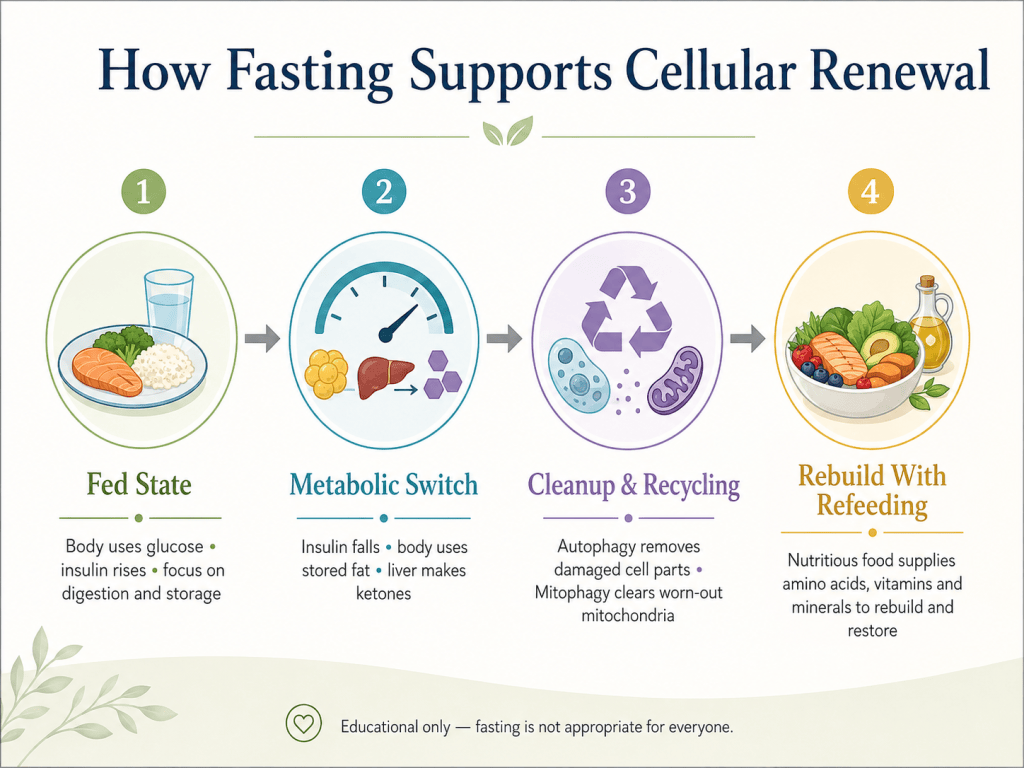
After a meal, the body primarily uses glucose from food for energy. Insulin helps move glucose into the cells and encourages the body to store excess energy.
As fasting continues, insulin levels decrease and the body begins using more stored fat. The liver converts some fatty acids into substances called ketones, which can provide energy for the brain, muscles and other organs.
Researchers sometimes call this transition the metabolic switch—the movement from primarily burning glucose to using more fatty acids and ketones.
The timing is different for everyone. It may depend on the person’s most recent meals, activity level, metabolism, liver glycogen stores and overall health.
The Body’s Building and Maintenance Signals
Two important cellular systems involved in fasting are known as mTOR and AMPK.
Think of mTOR as a construction manager. When food, protein and insulin are plentiful, mTOR encourages the body to build proteins, grow tissue and store nutrients.
AMPK acts more like an energy monitor. When energy becomes limited, AMPK tells the cell that it may not be the right time for expensive construction projects. Instead, the cell begins conserving energy and looking for materials that can be recycled.
During fasting, mTOR activity generally decreases while AMPK-related signaling increases. This shift helps create conditions that support cellular cleanup.
Neither system is bad. We need mTOR to maintain muscle, heal wounds and rebuild tissue. We also need AMPK and other maintenance pathways to help cells respond to periods of low energy.
Good health depends on moving between both states: building and maintaining.
Autophagy: The Cellular Recycling System
One of the most discussed effects of fasting is a process called autophagy.
The word autophagy means “self-eating,” but it does not mean that the body randomly destroys healthy cells. Autophagy is a controlled recycling and quality-control system.
Cells identify damaged proteins, worn-out structures and other materials that are no longer functioning properly. These materials are enclosed, broken down and recycled. Some of the smaller parts may then be reused for energy or to build new cellular components.
Autophagy may help remove:
- Damaged proteins
- Worn-out cellular structures
- Unneeded cellular material
- Certain microorganisms inside cells
- Components that are no longer operating efficiently
A helpful comparison is renovating a house. Before installing new cabinets, flooring or appliances, the broken and outdated materials must first be removed.
Autophagy acts like the demolition, sorting and recycling crew.
Researcher Yoshinori Ohsumi received the 2016 Nobel Prize in Physiology or Medicine for discoveries involving the mechanisms of autophagy. His work helped scientists understand that cellular breakdown is not simply destruction—it is also an essential part of renewal.
Mitophagy: Cleaning Up the Cellular Power Plants
Fasting may also influence a specialized form of autophagy called mitophagy.
Mitophagy is the process through which cells identify and remove damaged mitochondria.
Mitochondria are often described as the power plants of the cell because they convert nutrients into usable energy. When mitochondria become damaged, they may produce energy less efficiently and contribute to oxidative stress.
Rather than allowing poorly functioning mitochondria to remain inside the cell, the body can label them for removal. The damaged parts are then broken down and recycled.
This is one reason fasting may be viewed as more than a weight-loss strategy. It may also support the body’s cellular quality-control systems.
Scientists are continuing to study whether fasting can encourage the production of healthier mitochondria. Much of the detailed research has been conducted in animals or laboratory settings, so it is important not to exaggerate what is currently known in humans.
Ketones Are More Than Fuel
During fasting, the liver produces a ketone called beta-hydroxybutyrate, also known as BHB.
The brain and other organs can use BHB for energy when less glucose is available. Researchers have also discovered that BHB may act as a signaling molecule.
This means ketones may do more than provide emergency fuel. They may influence how certain genes operate and how the body responds to oxidative stress and inflammation.
This does not mean fasting automatically treats inflammation or prevents disease. Human biology is complicated, and findings from laboratory and animal studies do not always produce the same results in people.
Still, this research helps explain why fasting may affect more than body weight.
Refeeding Is Part of the Process
Fasting is only one phase of the renewal cycle.
During fasting, the body may reduce some growth-related activities while increasing its reliance on stored and recycled materials.
When nutritious food is reintroduced, the body once again receives amino acids, vitamins, minerals and energy. Insulin and mTOR signaling rise, allowing the body to manufacture proteins, maintain muscle and rebuild tissue.
Think of fasting as the cleanup phase and healthy refeeding as the reconstruction phase.
Both are important.
The goal is not to remain in a state of deprivation. The body needs a healthy rhythm between:
Growth and cleanup.
Breaking down and rebuilding.
Using energy and restoring energy.
This is also why longer fasting is not automatically better. If fasting continues for too long or is done improperly, it may contribute to muscle loss, nutrient deficiencies, dehydration, electrolyte imbalances and other health problems.
The Takeaway
Fasting is not simply about eating less or watching the number on the scale.
During a fasting period, the body may:
- Lower insulin levels
- Shift from glucose toward stored fat and ketones
- Reduce certain growth signals
- Increase energy-conservation pathways
- Recycle damaged cellular material
- Remove poorly functioning mitochondria
- Prepare the body for rebuilding during refeeding
Scientists still cannot say exactly how many fasting hours are required to produce significant autophagy in every person or organ. The effects depend on the individual, the length and type of fast, overall health, activity level and the quality of the refeeding period.
Fasting should therefore be understood not as a miracle cure, but as a biological state that may temporarily redirect the body’s resources from constant digestion and growth toward cellular maintenance, recycling and renewal.
References
- Ohsumi Y. Mechanisms of autophagy. Nobel Prize in Physiology or Medicine, 2016.
- de Cabo R, Mattson MP. Effects of intermittent fasting on health, aging and disease. New England Journal of Medicine. 2019.
- Youm YH, et al. The ketone metabolite beta-hydroxybutyrate blocks NLRP3-mediated inflammatory disease. Nature Medicine. 2015.
- Palikaras K, Lionaki E, Tavernarakis N. Mechanisms of mitophagy in cellular homeostasis, physiology and pathology. Nature Cell Biology. 2018.
This article is for educational purposes only and is not intended to diagnose, treat or prevent any medical condition. Fasting may not be appropriate for everyone. Longer fasts should be medically supervised, especially for people taking medications or living with diabetes, kidney disease, liver disease, low body weight, pregnancy, an eating disorder or another medical condition.

